
My grandmother told stories the way other people breathe.
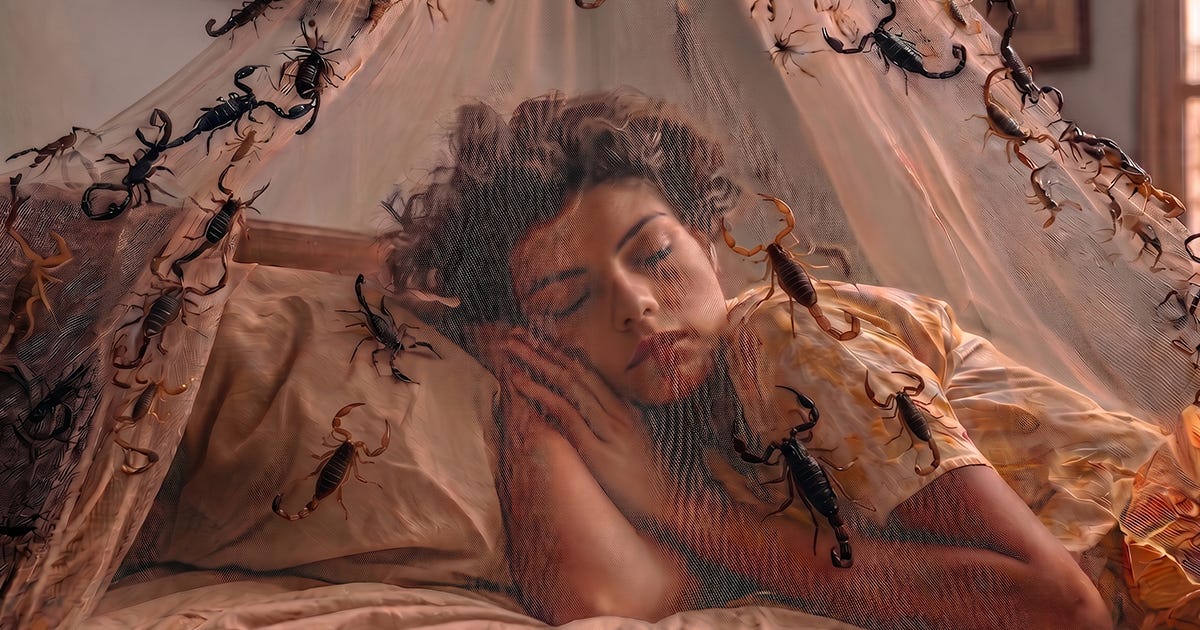
She told me of a woman who slept under a mosquito net that filled with scorpions every night. In her world, the scorpions were not the problem. The scorpions were the protection. They kept the snakes out.
I’ve never once tried to check it. That’s the point. There was nothing to check. She wasn’t selling anything. She handed me a world where scorpions guard you from snakes while we had coffee.
There were cups at the Ramla–Lod market that “asked my mother” to buy them. Out loud, in the stall. The seller was “mistreating them,” they said, and they wanted to come home with her. So they did. We owned cups we didn’t need, rescued from a man cast as the villain of the inanimate.
Same faculty. A world improvised in real time, vivid enough to stand in. A reader would file both under magical realism. The scorpions, the cups. The difference is casting. My grandmother’s worlds had no parts in them; you visited, and then you had lunch. My mother’s had people inside, and the people had parts to play, and the parts were assigned. Someone abuses. Something suffers. She rescues.
That is the whole difference, and it is not a difference of talent.
And I took it all at face value. Not belief, exactly. Not doubt either. When you grow up where this is normal, you don’t fact-check the house you live in. The scorpions and the cups arrived the same way — same door, same warmth — and I filed them in the same drawer. That’s where it gets tricky. One of those stories had a real man in it.
The patent application was due in three days.
It was two in the morning. The whiteboard covered an entire wall. I wasn’t a computer scientist. What I had was an animation background and an idea that wouldn’t let me sleep.
The idea was not augmented reality. AR existed. The idea was a platform. Photoshop for AR. A visual tool where an animator could build the illusion: track a person’s body with an ordinary camera, layer them into an impossible world, in real time. No motion capture suit. No markers. No code. Just a person, a webcam, and one tracking point.
I drew all seven figures myself. My wrist ached from the mouse. Patent drawings have rules. I didn’t know the rules, so I drew until it looked right.
The hardest part wasn’t the drawings. It was translating what I knew as an animator into the language of claims and specifications. Into something defensible.
The attorney wanted three tracking points. Industry standard for skeletal tracking.
But that wasn’t true. Three was better. One was enough.
We went back and forth for two days. She argued technical validity. I argued minimum viable reality. On the third day she conceded.
I fought three days to keep a single word. One.
I didn’t know yet that I was writing the physics of my mother’s house.
She didn’t need forty-four claims. She needed one.
One verifiable story. One name that checked out. One date you could look up and find real. Everything after that could be anything at all.
One tracking point, properly placed, locks the whole illusion.
I proved it, on paper, and a patent office agreed with me.
People talk about breaking generational patterns. In my family, nothing gets broken. It gets repurposed. The scorpions never leave the net. Someone just decides what they keep out.
I sat at my desk, and opened the pitch deck.
We empower the creative industry by providing easy access... Our patent-pending platform enables anyone... no technical skills required...
I’d said these words hundreds of times. To accelerators, investors, conference halls. I’d learned to say them the way you learn to sing. Not thinking about the words, just the delivery. The eye contact. The pause before strategic partnerships. The slight lean forward on immersive experiences.
Real-time visual effects can create an infinite amount of illusions... giving it a natural look...
An infinite amount of illusions. A natural look.
Through the wall, I could still hear my mother’s voice, the low warm tone she used for her clients. Somewhere on the other side a man was paying by the hour to have his blocks cleared, his reality refined, his world re-rendered into something he could bear.
I closed the deck.
We were both selling overlays. The difference was that mine had a patent.
I opened the deck again. I had a round to close.
The Keeper of the Mundane · A memoir.
My grandmother’s stories. My mother’s cosmology. My record of both.