
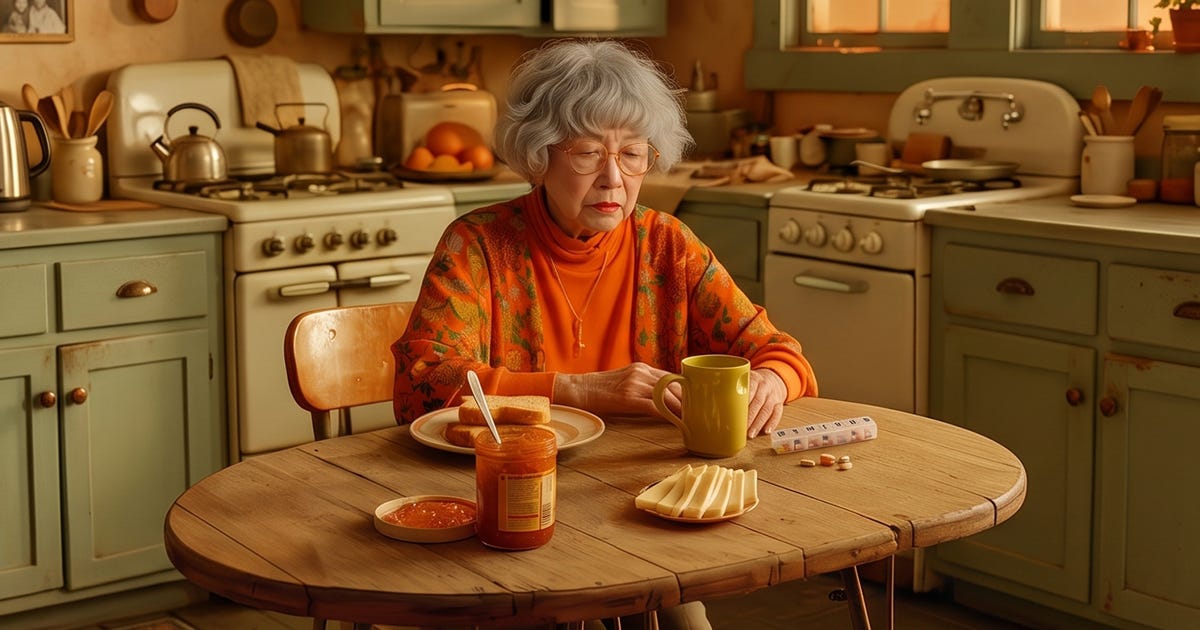
There is a refrain in my book. Pills. Toast. Cheese. Jam. On the page it reads like a ritual, a grandmother’s kitchen table, warmth. In life it was a shift. A daily one, with no relief coming, because I was the only person in her universe, and my universe was full.
She was a marvelous storyteller. She would tell me about a stranger who walked in one night with a bullet wound full of worms, told the way you’d describe finding ants in the sugar. Or the woman on the side of the road she nursed back to life. Literally. With her mouth. The milk was trapped, she explained.
She was ninety-two and still dressed for the elderly club to find a boyfriend. Wig on, perfectly matched colorful clothing, and her signature coral lipstick. The manager there told me she sat all day like furniture. I got the other version, the one who came home with reports of lectures and exercise classes, invented so I wouldn’t worry. I was her whole audience.
When I left in the morning, the show closed.
The rest of the day I was working. When I went out I took her with me when I could. Dinner with friends, my siblings, a normal life, except normal isn’t easy with a ninety-something at the table. Some nights she dazzled the room with her charisma even though nobody understood a word she said. Some nights she was a quiet thing in the corner who needed prompting to take three bites.
That is the arithmetic of the thing. Being someone’s whole world when you already have one. Knowing you’re the only one who can reach her, and knowing you cannot be there twenty-four hours a day. And the resentment that comes with it, which nobody wants you to say out loud, so I’ll say it. The resentment comes.
Almost four years after I got her out of that house, I went to Greece for two weeks. Cousins covered, the way people say yes to a favor they wish you hadn’t asked. She fell. It just happened. Nothing broke, nothing a scan could find. Something inside her broke anyway. When I came back she couldn’t walk and she barely spoke. She ended up in a rehabilitation center, the kind with fluorescent lights and food that arrives pre-mushed.
I was furious at everyone, everywhere, except at the two people who should have been first in line and weren’t even in the building.
So I came to that godforgotten place almost every day after work, and I helped her up and she walked. She actually walked, the woman was not even speaking. For the physiotherapists she couldn’t even stand up. She wouldn’t do it for strangers.
But I couldn’t be there every hour of every day. And the hours I wasn’t there, she stopped.
Keeping someone’s spark lit means that when you aren’t there, the spark is out.
And that kills me. Because I know that if I gave her my all, her universe could be so much richer. And so much hollower for me.
Here is what the guilt actually knows. It isn’t that what I gave wasn’t enough. It’s that even my all would have been enough only to keep a faint memory of her alive. Not her. A memory of her.
You can’t do it resentful; it doesn’t work. You can’t do it forced; forced becomes resentful. So you give your all when your all is available, and that is just not enough. Not because you’re failing.
Because the spec was written for a village and handed to one.
The literature on burnout guilt will tell you it’s a distortion. You’re doing enough. Be kind to yourself. Release it. The literature is right. But what it’s asking you to release is the love. It’s asking you to dismiss the guilt while you watch what your distance does to her. A nurse isn’t supposed to get attached to a patient. Fine. But this was the woman who changed my diapers. Who took me everywhere she went when I was small, so I wouldn’t be the surface my mother’s fury landed on. The one who raised me. So I’m sorry. The theory is harder to execute.
The guilt isn’t that I failed her. It’s that I was the only one who could reach her. The guilt was correct. Also unbelievably unfair.
Two of her children abandoned her. They made her the villain in the story of their lives, because that was easier than living ordinary ones. They traded their mother’s dignity, her peace, her health, everything, for a story that explained why they weren’t the most successful people on earth. I still don’t know why every inadequacy they saw in themselves was a bill she paid. But that’s what they did with her. That’s the ledger.
On the days she spoke, in that place, it was about them. Mis hijos, she said. Qué voy a hacer con mis hijos. What am I going to do with my children. Not for them. With them. As if they were a problem she hadn’t solved, a hem she hadn’t finished, something still open that needed closing.
They didn’t come.
It could have been shared. It should have been shared.
And shared, it would still have been a memory we were keeping lit. Not her.
But ok.
The Keeper of the Mundane · A memoir.
My grandmother’s stories. My mother’s cosmology. My record of both.
Instagram · YouTube · KeeperOfTheMundane.com
Personal essay, adapted from my memoir. Events as I lived them and as family members have sworn to them. No one here is named. People shown are generated images, not real footage. The judgments are mine.