
If my story reads like a novel, there’s a reason.
My mother built one.
She was the author. She constructed a narrative with heroes and villains, with soul hierarchies and divine intervention. It had structure. It had rules. It had an internally consistent cosmology that could absorb any contradiction and spit out a justification.
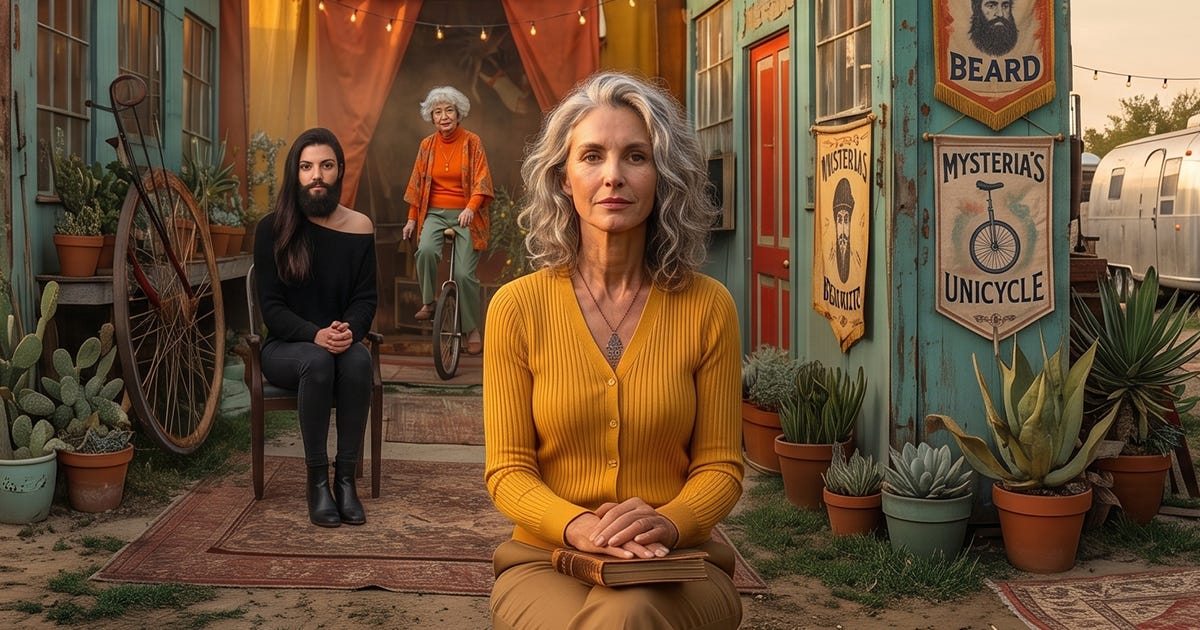
That’s not mental illness. That’s craft.
The shelf has names for mothers like mine. Dreamers, at the fond end. Emotionally immature parents, at the clinical one. The terms fit, and they’re too small: immaturity describes what she lacked. It doesn’t describe what she built.
The heart there is drama and make-believe: every small thing a scene, every scene a lever. My grandmother reached ninety and needed care, and instead of the boring machinery of looking after someone, the solutions, the schedules, the help, my mother made her the enemy, and convinced the house that a ninety-year-old woman was the root of all evil.
Make-believe was never the problem. Belief was.
When she believed her own lies, she was an eccentric with a gift for metaphors.
The story was hers alone. When the rest started believing them, it became a family cult. I grew up in a family cult. A congregation and a doctrine that could absorb anything.
I was a character in her story for decades before I understood I was allowed to leave.
She called me Dolly because to her I looked like a doll. It’s not an Ecuadorian name. It’s not a Hebrew name. It’s the thing she wished I was. But I wasn’t. Not compliant enough to love, not defiant enough to hate.
So I found my own job. One she could stomach. The janitor. Cleaning up behind the scenes, trying to fix the unfixable without letting anyone know it was broken. The only line I ever wrote into her story myself, and it was my job description.
She learned early that the story wins. Her mother taught her that, by believing first and questioning never.
I tried to tell people. For years.
But I didn’t have the magic. I just had the facts. And facts, without the spell, sound like a lie.
My mother will never write her own story.
Not because she lacks imagination. She’s brilliant. She can’t write it because her version can’t survive the page.
It only works in real time. In the room. With the eye contact. With her voice, her timing, her hands shaping invisible architectures in the air.
On paper the tracking points show. On paper the contradictions don’t dissolve. On paper you can see the architecture, and once you see it you can’t unsee it.
And the page is too still.
Writing requires containment. A sentence has to end. A paragraph has to hold its shape. A story has to sit still long enough for someone else to read it.
Her energy is absolute. It doesn’t illuminate, it consumes. She can’t sit still. The chaos won’t let her.
For years I wanted her to write.
I thought her talent was trapped by circumstance. By us. I wanted her genius to go somewhere that wasn’t us.
I wanted her genius to go somewhere that wasn’t us.
I had it backwards.
The genius was never trapped. It was already where it wanted to be.
That’s why she needed a follower’s devotion. Her sister’s illness. Her mother’s dignity.
The art needed fuel.
We were the fuel.
The Keeper of the Mundane · A memoir.
My grandmother’s stories. My mother’s cosmology. My record of both.
Instagram · YouTube · KeeperOfTheMundane.com
Personal essay. Events as I lived them. No one here is named. People shown are generated images, not real footage. The judgments are mine.