
The house was vast for Mom and me. Marble floors, glass walls, rooms that echoed when you walked through them. The kind of house that insists on being admired. It was beautiful. It was also enormous, which meant there were places to disappear.
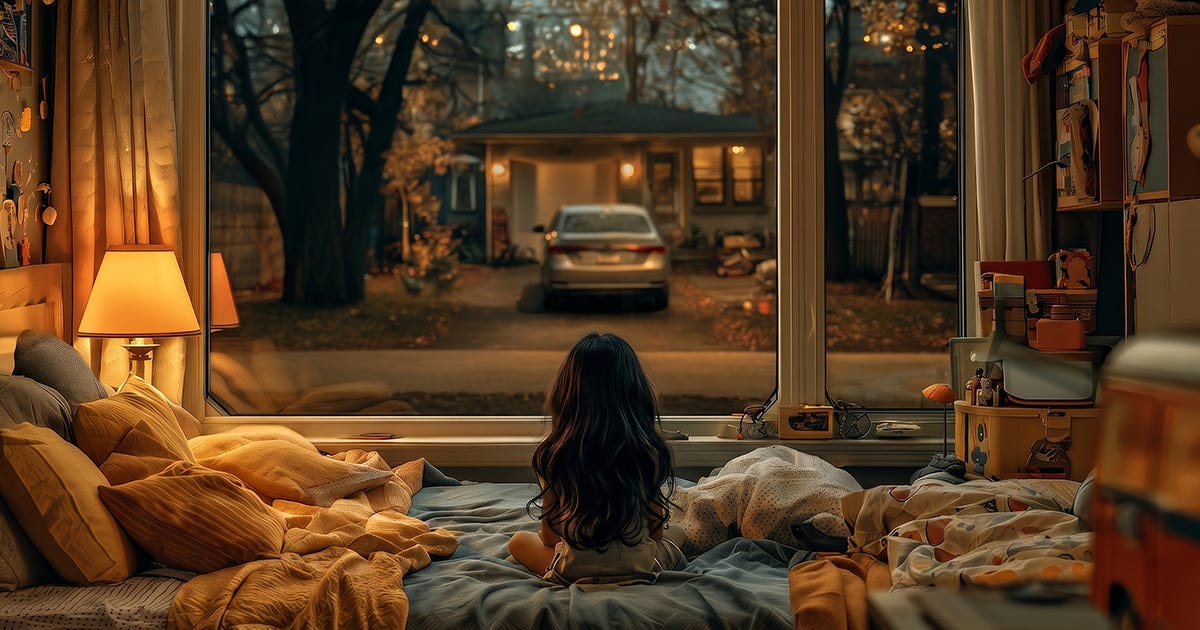
My room faced a little garden, and the garden faced the parking lot. Through it I could hear everything that mattered: the gate, the driveway, the engine cutting off. The car pulling in was the only clock I needed. It meant she was home. It meant the house was about to change temperature.
She was marvelous most of the time. The mother other kids wanted: beautiful, bright, funny, electric. And when she wasn’t marvelous, she was terrifying. Not always violent. Sometimes just a shift. A cooling of the air, a silence that bites. You couldn’t predict it. You could only learn the weather patterns and act accordingly.
I was five, maybe six. Old enough to understand that the good moments were wonderful, but they came bundled with the possibility of the other ones, and the other ones were bad enough that the bundle wasn’t worth it.
So I skipped both.
When I heard the car, I stayed in my room. I read, or I slept, or I pretended to do either. The goal was simple: don’t give the storm a surface to land on.
On one particular day, it was my birthday. I don’t remember which one, or if there was a cake, or a plan. What I remember is the car pulling in, the engine cutting off, and me in my room, doing exactly what I did every other day.
Not hiding from a monster. Hiding from the chance of one.
I don’t know if I came out.
It isn’t damage, what that girl was running. I’m not damaged. It’s exhausting.
The ability to observe never stops, and it runs far beyond the normal rate. It reads rooms. It reads faces. It reads the weather. It can see a no forming on a mouth before its owner knows he’s decided. Didn’t you see how he was shifting in his seat? It caught, at five, through a garden, the difference between an engine cutting off in a good mood and an engine cutting off in a bad one. Eventually it read markets, products, teams.
I wasn’t always like this. At twenty I was ashamed to walk into a shop and buy cigarettes. The wiring saw everything and reacted to nothing, because at five, reacting was the dangerous part.
But a life in hiding is brutal, and the price of hiding stopped being sustainable. I don’t care anymore who likes me and who doesn’t. The ability to see everything makes you the most dangerous person in the room, only if you’re willing to wield the sword. It’s nice, being able to be a beast. It’s less nice not controlling when it shows up.
I don’t watch television. I can’t sit on a beach; I need trips, movement, a route. My idea of doing nothing is playing video games while listening to a book, because doing nothing does not compute. Every room I walk into gets read. Every shift of tone gets logged. Every question lands, for half a second, as an attack, and I would give a great deal to see and just let it drop. I can’t.
And it makes me angry when others don’t see it. It’s right there. Can’t you see it. The anger isn’t superiority. It’s a misread, for half a second, the not-seeing lands as deliberate. Weaponized incompetence. An attack. It’s neither. It’s people whose engines never had to run to fumes. I know that. The system doesn’t.
Where I grew up, not seeing was a choice people made. And when I named what I saw, they denied it, and the denying denied me: nowhere to run, every door closed. So the wiring files every missed thing under that category. That is the loneliest part. At five, seeing was my whole job, and nobody else was on shift. Some part of me still believes nobody else is on shift, and it enrages me.
The literature calls it hypervigilance and files it as a symptom: a threat-detection system that never switches off, scanning long after the danger has passed. Correct, and written entirely from outside. From inside it even gets the tense wrong. You don’t scan because the danger is there. When it’s there, the scanning is over; you’re in it. You scan because it isn’t. Minute changes in the air, in the pressure. The whole job happens before the weather arrives.
It gave me my career. It may cost me my career one day. I’m not easy, and it’s not easy, seeing everything.
I believe a deficit creates a surplus somewhere else. I won’t dress that up as gratitude, and I’m not selling you adversity. It’s arithmetic. You pay for what you have.
I have. I pay.
The Keeper of the Mundane · A memoir.
My grandmother’s stories. My mother’s cosmology. My record of both.
Instagram · YouTube · KeeperOfTheMundane.com
Personal essay, adapted from my memoir. Events as I lived them. The judgments are mine.