
When my mother believed her own lies, the story was hers alone. When the rest started believing them, it became something else.
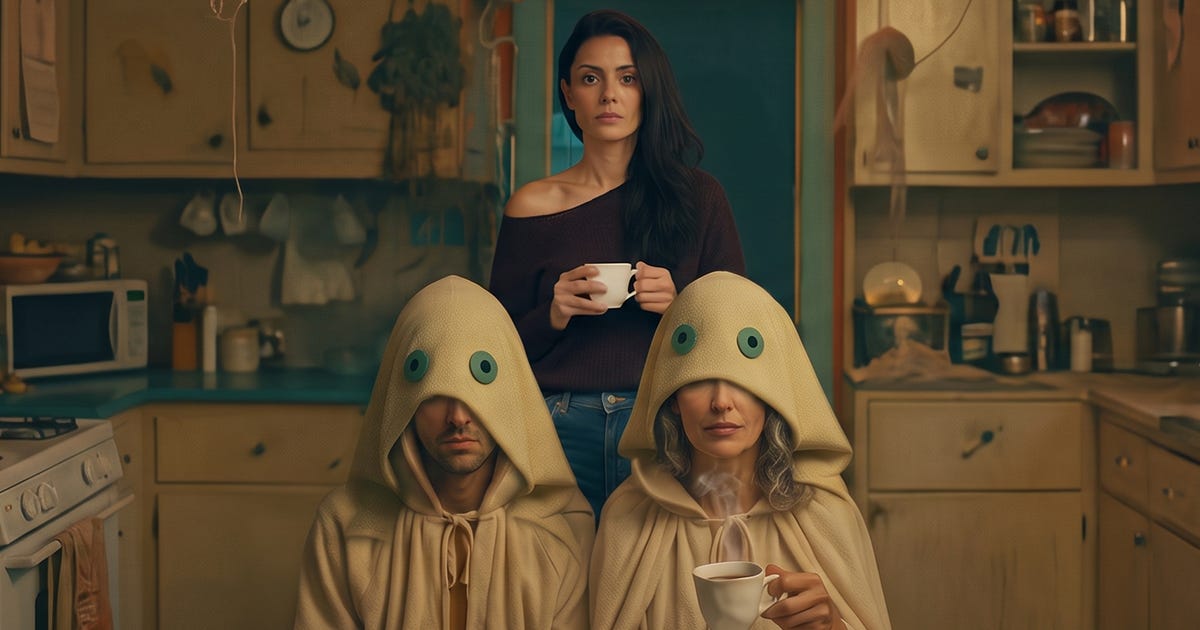
People ask what makes a family a cult, as if the difference is size, or robes, or a compound in the desert. It isn’t. The difference is one believer.
A private delusion is a quirk. A shared one is a system.
The day the second person at the table stopped checking the world underneath her words, we stopped being a family with an eccentric at its head and became a congregation.
There were no ex-members to find. No hotline, no documentary, no word for what we were. The researchers have a term, high-control group, and a checklist, the BITE model. My mother ran a perfect board out of one kitchen, without ever reading a word of the literature. Nobody writes case studies about a kitchen.
Too small to be studied, unseeable from outside, unspeakable from inside. From the street it looks like a family. Inside, everyone is too loyal, too involved, too guilty to name it. And clarity, when it finally comes to one of you, comes alone. Seeing it doesn’t make it visible.
Our scripture was whatever framework she’d discovered that month. Theta healing, Kabbalah, numerology, past-life regression. The content shifted. The structure held.
I grew up in a family cult. With evil vegetables and divine negotiations.
Dinner, one night. Her disciple cooked. Three plates, three proteins: fish for me, beef for my mother, chicken for him, each of us assigned our protein by the Creator personally. He looked at his plate and asked, “Am I allowed meat sauce?”
“You are not.”
A grown man. A wooden table. Sauce, cleared with God.
Cult research has a name for this, behavior control: the doctrine decides what enters the body. What is pure, what is impure, and who gets to decide what defiles and what purifies.
My sister’s brakes were failing once. The paper-thin, this-will-kill-you kind. The problem went up the chain: sister to uncle, uncle to my mother, my mother to God. God consulted the energy of the vehicle and found the brakes spiritually sound. The softness in the pedal was her own internal resistance, something to work through. She drove the car. Then my brother found out, got underneath it, came back inside and said: attempted murder. He fixed the brakes himself that afternoon. God’s assessment was not mentioned again.
Cult research has a name for this one too, sacred science: doctrine outranks evidence, and the cosmology can absorb any contradiction and spit out a justification. Almost any. It never did figure out brake pads.
I grew up in a family cult. Where the obedient had souls and the rest were hollow.
I ran a startup for a while. Fifteen interns from everywhere: the US, Ukraine, China, Hong Kong. My mother asked where they were from, nodded, and explained, in the tone you’d use for weather patterns, that Asians are born without souls. Not an insult, she clarified. Just how it is. Mine were good soulless. They wanted to be near me, because being close to someone with a soul helps them grow one.
The interns were one afternoon of it. The system ran on everyone, everywhere, all the time. The world divided into the ensouled and the hollow, and the border moved. A hollow one in good standing could acquire a soul: my dog, miracle of miracles, developed one by being near me. My sister, meanwhile, was losing hers. Going to the market with her was a tour of a map only she could see, the ensouled and the empty passing each other at the stalls. Drinking a coffee could turn into a skirmish, because the universe was a battleground: the hollow stole souls from the ensouled by tempting them into sin, and sin was whatever she was into that week.
And the man at the table nodded along to all of it: it’s in the Torah.
That nod is the whole institution. Every cult has its author, and every cult has its amen. The lieutenant who polices belief, whose agreement turns a woman’s mood into law. Alone, she was a mystic with a gift for metaphor. Seconded, she was a government.
Every cult has its author, and every cult has its amen.
The hierarchy wasn’t decoration. It decided what could be done to whom. My uncle, we were told, had sworn a soul oath before birth: he would never be able to enjoy his own property. Not his house, not his tools, not his room. All of it was enjoyed by her instead.
Which raises the question every reader of every cult story asks: how do grown adults end up here, one asking clearance for sauce, another grateful to be relieved of his own property?
For the disciple, I can’t tell you. He arrived already finished, a believer looking for an author. I never saw the person he was before, which is why I can’t write him as one. What I saw was the finished product: a man dragging wooden beams through a storm while she watched him from inside, dry, through the glass. If you had passed the house you would have seen a man doing heavy work in bad weather. You would not have seen the covenant.
My uncle is different. My uncle I watched happen.
Nobody joins a cult.
My uncle wasn’t born a believer. For years he could push back, disagree, love what she didn’t love. Then his sister got cancer, and the cosmology offered him the one thing he couldn’t refuse: a world where the dying woman wasn’t dying, where God took calls, where nothing had to be faced.
It wasn’t love that recruited him. Love sits with the dying and makes them smile while you crumble. What the doctrine sold him was the crumbling, cancelled. A sedative to life. That was the drug. The bill was paid by his ninety-year-old mother, wasting away upstairs, because every good story has a villain and cults excel at storytelling.
And once he took a dose, he couldn’t leave. To reject the theology he would have to see everything it had excused, and everything he had let it excuse, and what’s in that mirror nobody volunteers to see. The sunk cost of a cult isn’t money or years. It’s complicity. The stack of things you allowed can’t make you sick if seeing it means seeing yourself.
The sunk cost of a cult isn’t money or years. It’s complicity.
Sometimes I wonder how come it didn’t take me.
I would love to tell you I saw through it. I didn’t. The boiling frog works on everyone, including the one writing this. The parking-lot miracle was charming. The soul talk was eccentric. Absurd on Tuesday was just how things were by Friday. What I actually did, for years, was play along: nod, spray garlic water against the spiritual breach, go inside, make coffee. I never believed. I performed belief, which from two feet away looks identical, and costs less.
Until it didn’t. Until I saw the price of playing along, what it was buying and who was paying it, and it made me sick. Physically. Nauseated. Before I could name it. Before I could understand it.
It took years of distance to see it as clearly as I write it now. It is easy to be above it all today. I was not above it. I was in it, holding a spray bottle, nodding.
I grew up in a family cult. Where the record became resistance.
The way out was not an argument. Arguments went in and came back rearranged; everything I said returned dressed in spiritual clothing, loving clothing. So I stopped talking to people with answers. I started talking to doctors. Social workers. Anyone who still used words the way I used them.
And I started writing everything down. Fragments of conversation. Frozen moments my mind would rather forget. Words I hoped my future self would arrange into something coherent. What was actually said. What was actually served. Because a family cult’s last line of defense is that it owns the past: the story gets revised, the congregation nods, and your own memory starts asking permission.
Paper doesn’t nod.
So I wrote it down.
The Keeper of the Mundane · A memoir.
My grandmother’s stories. My mother’s cosmology. My record of both.
Instagram · YouTube · KeeperOfTheMundane.com
Personal essay. Events as I lived them. No one here is named. The beliefs described are my mother’s, reported, not mine. The terms are established concepts in coercive-control research. The judgments are mine.