
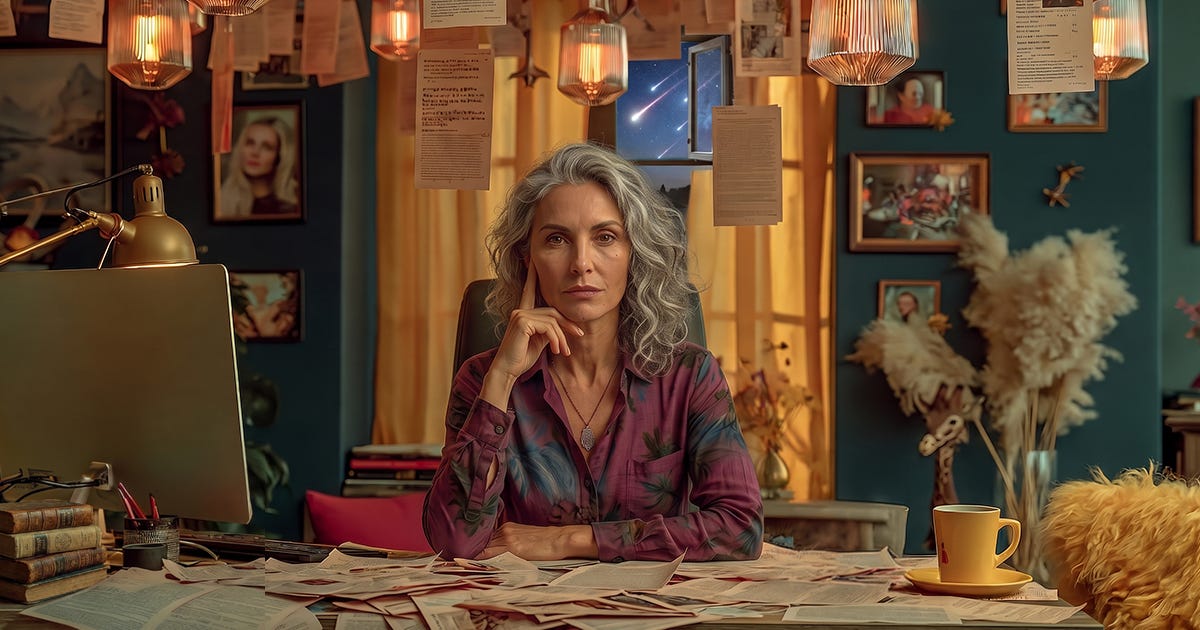
Kabbalists believe that divine light was poured into vessels. The light was too much for them. The vessels shattered, and the sparks scattered into everything, holy sparks, nitzotzot, buried in all matter, in every stone and stalk and person, waiting to be gathered back. That’s real Kabbalah, centuries old, and it is genuinely beautiful.
The world as a broken vessel, still full of hidden light, and every human act a chance to lift a spark home.
Thirty seconds ago you didn’t know that. Now you do. That’s the amaze, her mechanism.
Somewhere along the way my mother heard about panspermia. The hypothesis that life’s ingredients rode to Earth on comets and meteorites. Maybe a documentary. Maybe a paragraph somewhere. It doesn’t matter, because her cosmology had one machine at its center and the machine took everything: Kabbalah in one week, ancient-aliens documentary the next, a wellness newsletter after that. Trivia goes in. Doctrine comes out. The blender never jams.
So the sparks became seeds. The seeds became passengers. The falling light became falling life. Chai zar, she called it, strange life, foreign life. Alive, but not from God. Estranged from the Creator, raining down on every meteor shower, landing, growing, spreading. Soulless things falling out of the sky, waiting to take what you have and they don’t.
The fallen life was in the food now, and every food had a loyalty, some to the Lord, most extraterrestrial. At the table the contaminated thing was the food. On me, it was me.
Mine came from the Song of Songs. She decided I had been her — the dark bride, in a past life. I am dark, yet lovely. She chose her for me because I’m the darkest one in the family, and the theory needed a wound to fit. The danger is the yet. The safety is the verse. Both arrive in the same package, as a gift, sized to you.
It didn’t fit. The dark never bothered me. It bothered her. She told the story for years: when I was born she thought I was black, and asked my father whether he had dark relatives, and then asked Abue. So the fitting kept going, because a handmade danger that doesn’t take isn’t a failed product. It’s a reading. She went looking for the place where I was sore. I’d learned very young never to show her a sore. So she went poking. Then she found the hips.
We worked the garden together for hours, pulling weeds, separating pups off a plant, and I squat when I work. I’ve always squatted. Your hips are wider, she said. They dislocate. Neanderthal hips, it’s the Moroccan genes, that’s why you can squat for hours. I always thought it was bad manners, but it’s how your body is built. I kept pulling weeds.
I’m hypermobile; I was second in gymnastics in Ecuador, and being compared to a caveman isn’t the sting. The sting is watching her dig. That was the product, always. Not the theory. What she made by hand was inadequacy, and the theory was just how it got delivered. If you don’t feel inadequate, the guide has nothing to sell you.
My father is Moroccan. So is hers. I stayed down and never said it.
At 2am people type “my mom is a conspiracy nut” into a search bar. The literature they land on will tell them, correctly, why people believe conspiracy theories: they make sense of chaos. They compress a complicated, indifferent world into a neat story with hidden causes. They hand the believer a comfort zone and a tribe, something to belong to. That’s true of the believer. It says nothing about who made the theory, or what the believer does once he owns it.
She didn’t find a hostile world and explain it. She handed you one. Everything contaminated. Everything impure. The sky itself an invasion in slow motion, soulless visitors drifting down through the dark while you slept. And you. Inadequate, by verse, since the crib. And then, once the world was properly dangerous, and you were helpless, came the second half of the product, the half every conspiracy sells: the guide. You have to be careful. And she knows how.
That’s the entire business model, and it fits on a napkin. Manufacture the danger. Monopolize the safety. First she amazed you with what she knew; then she trapped you in a world where only she knew it. The knowledge that made you lean in is the same knowledge you now couldn’t live without. Wonder was the free sample. Dependence was the subscription.
Manufacture the danger. Monopolize the safety.
Order is what belief wants. Order needs control. So the wound opens, and the believer picks up the tool. My mother invented the alien food to decide what the house would eat. She didn’t have to enforce it. Her believers did that for her, at every meal, to everyone else. Her disciple, a grown man who had decided somewhere in his thirties that he was her son, bought the food, cooked it, served it. He controlled the house by being helpful. From the slave’s chair he ran the empire.
People come to conspiracy theories fleeing chaos, the studies say. Looking for the neat story, the safe room, the tribe.
The studies stop before the bill arrives. That kind of safety is bought the way it’s bought in every old story: with your soul, at the seller’s rate. Belief is the currency. You spend it on safety, and the safety only holds while the danger holds, so the danger never stops. You end on the losing side of the ledger no matter how faithfully you pay.
And the house always wins.
The Keeper of the Mundane · A memoir.
My grandmother’s stories. My mother’s cosmology. My record of both.
Instagram · YouTube · KeeperOfTheMundane.com
Personal essay. Events as I lived them and as family members have sworn to them. No one here is named. People shown are generated images, not real footage. The judgments are mine.